
Spot recourse potential before it's lost.
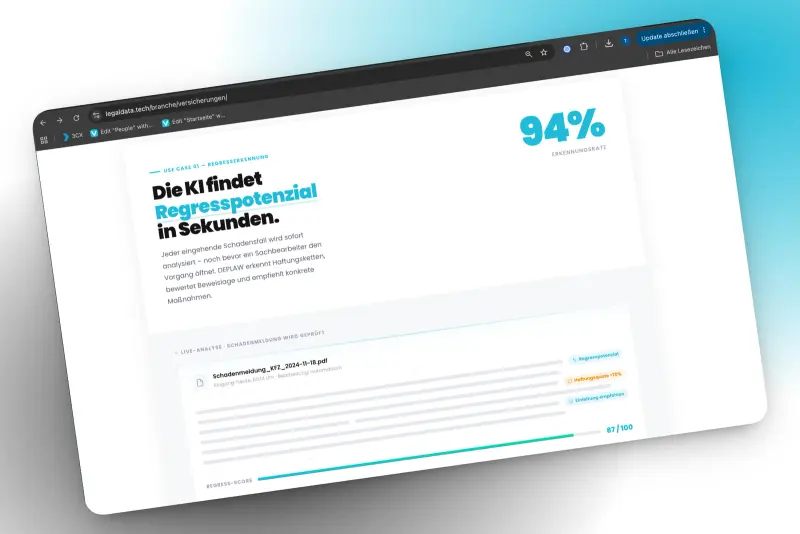
DEPLAW's AI-based recourse review automatically screens every claim file for attorney and liability recourse as well as reduction potential — and drafts a legally sound demand letter from it, without a claims handler needing to review the file by hand.
In use at insurers
The starting point
Recourse potential goes undiscovered — every overlooked file costs real money.
Volume
With hundreds of claim files a month, recourse claims routinely go undetected when review is done manually only.
Deadlines
Attorney and liability recourse claims lose enforceability with every day of processing time.
Expertise
Detecting recourse potential requires legal assessment in every single file — a bottleneck as soon as it's done manually only.
What AI recourse review does for insurers
Four levers for your recourse rate.
Detect recourse potential fully automatically
Attorney recourse, liability recourse and reduction potential are detected directly from the claim file — without manual review by a claims handler.
via AI reasoning layer in the file's context
Draft demand letters automatically
Attorney-reviewed templates are adapted to the specific case's claim amount, legal basis and deadline, and output ready to send.
via text generator
Tailor to your line of business
The model continuously learns from quality-control corrections and can be fine-tuned to your own, anonymized claims history.
via customer-specific fine-tuning
Document legally soundly & with a full audit trail
Every AI decision is traceably justified, every dispatch path logged for audit purposes — compliant with Art. 22 GDPR and the relevant regulatory standards.
via compliance log
How DEPLAW helps in practice
From an unstructured file to a solid claim.
Instead of handling liability review, cost control and letter drafting separately, every file runs through a single automated review path — each platform capability addresses a specific bottleneck in recourse processing.
Challenge
Unstructured, inconsistent claim files
DEPLAW solution
The unstructured claim file arrives via API or upload — DEPLAW reads every document via OCR (PDF, DOCX, JPG, XML) and automatically sorts it into six structured categories, on average in 8 seconds per file.
Challenge
Liability and reduction potential reviewed separately
DEPLAW solution
Two AI review phases assess the same file from two angles: Phase A checks liability, breaches of duty and signs of fraud, Phase B assesses cost items, reduction potential and inflated fees — in the example of a motor claim file, with an 87% recourse probability.
Challenge
From a finding to a solid claim
DEPLAW solution
The review results automatically produce a structured recourse report with claim amount and deadline — and directly from that, a ready-to-send, legally sound demand letter including legal basis and dispatch route.
Example · an incoming motor claim file
From an unstructured file to a demand letter — in three steps.
What that looks like in practice is shown by the recourse report for the same example file: the claim is broken down by claim item, and the resulting demand letter already states the legal basis, claim amount and deadline, ready to send.
Recourse report · example breakdown
Demand letter · example
The same review scales across your entire claims volume — not just a single file.
Adapts to your system landscape
Our customers see up to a 55 percent increase in recourse revenue in the first year after go-live — at a detection rate of over 94 percent.
Legal Data Technology · AI Recourse Review
Frequently Asked Questions
What insurers want to know before adopting.
The answers below summarize what business units, legal departments and IT most often want clarified about AI recourse review during project discussions — from technical detection accuracy through legal responsibilities and system integration to the payback period of the investment.
Technology & AI
The detection rate for recourse-eligible claims is over 94% — with an average analysis time of around 5 minutes per file, even for completely unstructured claim files.
DEPLAW processes all common formats: PDF, DOCX, XLSX, JPG, PNG, TIFF, as well as structured data formats such as XML and JSON. Recognized categories include claim notifications, expert reports, coverage inquiries, invoices, photo documentation, and rulings or court filings.
Yes. DEPLAW can be fine-tuned on the basis of your anonymized claims history and keeps learning from the corrections made during quality control.
Legal & Compliance
The generated letters are based on attorney-reviewed templates and adapted to the specific facts of the case. Every letter includes the correct legal basis (e.g. § 86 VVG, § 823 BGB), a precise claim amount, and a legally compliant deadline. An attorney quality check can optionally be added as a mandatory step before dispatch.
DEPLAW processes personal data exclusively on German and European servers (ISO 27001-certified), with no data shared with external AI providers. Automated decisions under Art. 22 GDPR are transparently justified. Details on the technical and organizational measures and the regulatory classification under § 32 VAG are available on the Security & Outsourcing for Insurers page.
DEPLAW is a decision-support system — final sign-off on a demand letter rests with the insurer or the instructed attorney. Responsibility for the decision therefore remains with a human.
Integration & Operations
DEPLAW offers a full REST API for bidirectional integration with existing claims systems (e.g. Guidewire, SAP Claims, eBroker or in-house systems). Typical integration time is 4–8 weeks including testing and go-live support.
Yes, via a native beA interface with automatic escalation if the opposing party fails to respond within the set deadline.
DEPLAW guarantees 99.9% availability (SLA). The infrastructure is geo-redundant across German data centers; in the event of an outage, files are automatically queued without data loss.
Cost & ROI
For mid-sized insurers with 500+ recourse cases per month, DEPLAW typically pays for itself within 3–6 months. Customers report an average of 35–55% higher recourse revenue in the first year.
Three options: volume-based per processed file, a monthly flat rate, or a success-fee model with a share of actual recourse revenue. All models include onboarding, integration, support and ongoing model updates.
We recommend a structured 60-day pilot with a defined subset of your claim files (typically 200–500 files). Pilot costs are credited against the full integration fee.
Further reading
Recourse in detail.
· Tim Platner
Regress-Automatisierung: Wie KI ungenutztes Regress-Potenzial erkennt und durchsetzt.
Wie DEPLAW mit KI-Agenten Regressansprüche in Schadenakten von Haftpflicht-, Rechtsschutz- und Krankenversicherern systematisch erkennt, bewertet und durchsetzt.

· Tim Platner
Regressansprüche nach § 116 SGB X: Wie öffentliche Träger Millionen mit Legal Tech durchsetzen
Sozialleistungsträger erhalten bei Regress kraft Gesetzes Ansprüche gegen Schädiger – ohne System verjähren viele davon ungenutzt. Wie DEPLAW hilft.
Unlock your recourse potential.
We'll show you, using one of your real claim files, how AI recourse review automatically detects liability, reduction potential and demand letters.
Book a demo for insurers