

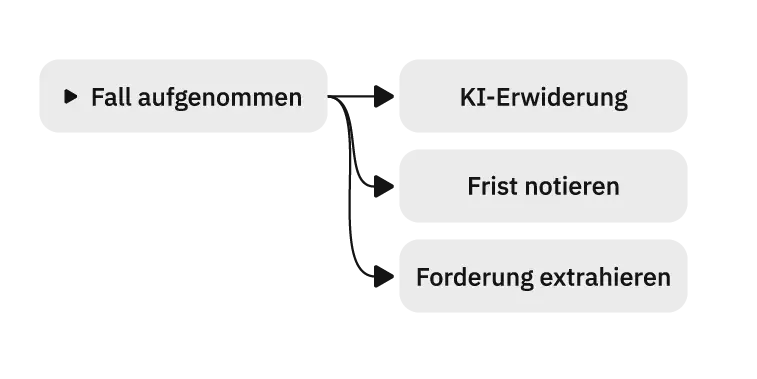
Anyone who has used BPMN for legal case handling does not want to go back: the freedom and level of detail that orchestration offers are simply compelling.
A technical term with far-reaching practical consequences: anyone who understands how BPMN works also understands why most automation promises in the legal tech market fail in the long run – and what a solution needs in order to scale in practice.
01 Closed shop
The problem with proprietary workflow engines
Imagine that over two years your company has built dozens of automation processes, all in the proprietary workflow engine of one particular software vendor. The logic sits inside the system, but it is hardly documented in any real sense; nobody outside the platform can read or follow the processes.
Then one of several things happens. The vendor discontinues the product. Or it raises its prices drastically. Or the company outgrows the capacity of the platform.
What happens then to your own processes? They are lost. Not the data – that can usually still be migrated – but the process logic, the decision rules, the actual automation intelligence: all of it trapped in a proprietary format that no other system can read.
This is not a hypothetical scenario but the reality for many companies that relied on proprietary solutions in the first wave of legal tech digitalisation. BPMN is the structural answer to exactly this problem.
02 Short and sweet
What BPMN is: the short version
BPMN stands for Business Process Model and Notation. Behind the unwieldy name lies something quite fundamental: an internationally standardised language for describing business processes so unambiguously that machines can execute them.
BPMN is used worldwide and across industries – from the automotive industry and banking to public administration.
At its core, BPMN is a graphical notation: circles, rectangles, diamonds, arrows. Each symbol has a precise, standardised meaning. Put together, they form a process that can not only be visualised but also executed directly – without a detour via code.
Try it for yourself: the interactive demo below lets you recreate a first BPMN workflow.
The most important BPMN elements at a glance:
- Start and end events: define the beginning and end of a process
- Tasks (service task, user task, script task): automated or manual tasks
- Gateways (exclusive, parallel, event-based): decision points and branches
- Sub-processes: reusable process building blocks within a workflow
- Event sub-processes: handling of exceptions and unexpected events
- Timer events: deadline- and time-driven actions
- Message events: reaction to external events (e.g. an incoming message in beA, the special electronic lawyers’ mailbox)
03 Looks or function?
BPMN in the legal sector: what can be modelled with it
BPMN shows its full potential in a legal environment – precisely because legal processes are often complex, rule-bound and full of exceptions. Four examples of processes that are automated in production today using BPMN-based workflows:
-
Case intake and initial processing
- Incoming documents (beA, email, upload) automatically trigger the appropriate workflow
- AI-based classification as a service task: document type, priority, time sensitivity
- Automatic assignment to the right case file, the right case handler and the right follow-up process
-
Deadline management and escalation
- Timer events set deadlines automatically on the basis of data extracted by AI
- When a deadline passes without a response, escalation workflows automatically start a reminder process
- Event sub-processes interrupt the main process in a controlled way when unscheduled events occur, such as an unexpected incoming item
-
Court payment order proceedings
- Fully automated generation of online applications for payment orders
- Tracking of service and automatic start of enforcement processes in the event of non-payment
- Parallel gateways start and monitor several debt collection measures at the same time
-
Communication with all parties involved
- Automatic, context-based dispatch of pleadings via beA, email or post
- Proactive status updates to clients without manual effort
- Standardised, documented and version-controlled correspondence with the opposing party
The good thing about BPMN for law firms and insurers: you can start with small sub-processes and gradually add all the steps before and after, without having to start again from scratch. In my view, there is no better standard for complex automation projects in the legal sector. – Tim Platner, Managing Director of Legal Data Technology GmbH
04 Perfect match
FEEL: decision logic that completes BPMN
BPMN describes how a process runs. A second question is at least as important: why does a process take exactly this path at a given point and not another?
FEEL answers this question – Friendly Enough Expression Language, the associated standard for decision logic. FEEL is a readable, standardised language in which if-then rules can be formulated explicitly.
Instead of hiding decision logic in code, where nobody except developers can read, check or change it, rules are formulated in FEEL in such a way that lawyers, caseworkers and compliance officers can understand them directly.
Typical FEEL decision rules in a legal context:
- Automatic approval of legal action: amount in dispute <= 2000 and probability of success >= 70 and type of cover = “Private legal expenses insurance”
- Escalation to a supervisor: processing time > 30 and client status = “Complainant” and amount in dispute > 10,000
- Automatic settlement proposal: opposing party’s offer >= amount in dispute × 0.7 and costs of proceedings > amount in dispute × 0.3
Lawyers and caseworkers can define, check and adjust these rules directly – without any developer skills. This is no-code/low-code automation at enterprise level.
05 Standards
Right rather than easy
The market offers numerous legal tech tools with simple workflow functions. Such tools can certainly be useful as a way into automation. In the long term, however, they create specific risks:
| Risk | Proprietary solution | BPMN-based solution |
|---|---|---|
| Vendor lock-in | Process logic in a proprietary format – not portable | Complete BPMN 2.0 export – system-independent |
| Change management | Every change requires developers | Business users adapt processes directly |
| Auditability | Process logic hidden in code – hard to explain | Process steps and decisions traceable directly in the model |
| Scalability | Performance limits at high volumes often undocumented | Enterprise architecture with defined scalability |
| Exception handling | Exceptions often handled manually or as code workarounds | Event sub-processes: exceptions explicitly modelled |
| Compliance | Process logic hard for supervisory authorities to review | Complete process transparency for audits |
| Future-proofing | Dependent on the vendor’s roadmap | Open standard – vendor-independent |
06 Process deadline
BPMN × AI: how process-driven AI works
Generative AI is powerful. But AI that acts in isolation and autonomously is problematic in an enterprise environment: uncontrollable outputs, lack of auditability, inconsistent results.
The BPMN approach solves this problem elegantly: AI is not deployed as an autonomous agent but as a service task within a defined workflow. In concrete terms, this means:
- AI requests have a defined input: which documents, which data points, which prompt
- AI responses have a defined output: which data is extracted, which action follows
- AI steps are versioned: which model was used, and when?
- AI results are auditable: every request and every response is documented in the process history
- AI is interchangeable: switching models (GPT-4 → Claude → local model) requires no change to the process
The result: AI that does not act autonomously but is orchestrated in line with the business logic – powerful and controllable at the same time.
07 DEPLAW for enterprises
Who BPMN is suited to in legal tech – and who it is not
BPMN is not a cure-all. It is a powerful tool, but one that requires a certain investment in process thinking.
| BPMN is the right approach if … | BPMN may not be the right starting point if … |
|---|---|
| You want to automate recurring legal processes at high volume | You only have a few, very complex individual cases with no recurring processes |
| You want to understand, design and change processes yourself – without developers | You have no subject-matter resource who can design processes |
| You must meet regulatory requirements for traceability and auditability | You are looking for a quick start without in-depth process analysis |
| You need a long-term, scalable solution without vendor lock-in | You are planning a small digitalisation project of limited scope |
| You want to embed AI in auditable, controllable processes | You mainly want to use AI as an interactive assistant tool (chatbot etc.) |
08 Conclusion
BPMN is not just technology, but strategy
The choice between BPMN-based process automation and proprietary workflow tools is not a purely technical decision but a strategic one. How much control do you want over your own processes? How independent of individual software vendors do you want to remain? How traceable must your automation decisions be for internal and external auditors?
For law firms and insurers that want to automate legal processes seriously and for the long term, BPMN is today the only approach that answers all three questions convincingly.
It is no coincidence that BPMN has become established as a standard in regulated industries – banks, insurance companies, public administration. It is the result of years of experience of what works in the long term and what does not.