

What for years required expensive specialist software and entire teams of case handlers, generative AI now delivers at the push of a button. This shifts the structural balance of the legal market, with consequences for courts, law firms and everyone on the opposing side of mass proceedings.
The mechanics of mass litigation have been familiar for years: diesel emissions, air passenger rights, revoked loan agreements. Specialist law firms and legal tech providers have learned to process uniform claims on an industrial scale. What is new is that the barrier to doing so is now falling. Generative AI takes over the assembly-line work that used to tie up capital and staff, and so makes the model applicable to areas of law that have so far been spared.
Marc Ohrendorf, a legal technology expert at Bucerius Law School, described this development in an article for beck-aktuell in June 2026. His finding: the economic brake that procedural law has represented for decades is dissolving. When drafting a claim costs next to nothing, bringing one becomes worthwhile even where the effort once ruled it out.
“Until now, this pattern was confined to a handful of case groups. Generative AI removes that restriction. Tenancy law, consumer protection, employment law: the special case becomes business as usual.”
– Marc Ohrendorf, Bucerius Law School
The numbers behind a development that began long ago
The Stuttgart Higher Regional Court (OLG Stuttgart) shows how far mass proceedings can push a court to its limits. It has used its AI assistant OLGA in diesel cases since 2022. There, the number of appeals rose from around 1,700 in 2018 to about 17,000 in 2023. The vast majority were diesel cases, with pleadings in some instances running to more than a hundred pages, although only a few data points decide the outcome.
The social courts show that this development is not confined to classic mass proceedings. In North Rhine-Westphalia, the number of interim relief proceedings rose by more than 55 per cent to 7,615 in 2025. A major driver is citizens who represent themselves without a lawyer, using AI. What specialist law firms do at the top end of the market, private individuals do at the bottom. The effect on the courts is the same.
Two speeds, one widening gap
While law firms and even consumers automate their pleadings, the judiciary continues to deal with the flood of claims largely by hand. The projects meant to change this exist. OLGA in Stuttgart categorises and structures diesel appeals, MAKI in Lower Saxony is trialling AI-supported handling of mass proceedings, and in Hesse FRAUKE and FRIDA have produced further applications. But these projects remain islands: regionally confined, with no uniform nationwide system.
What this means for defendants in mass proceedings
Most of the debate focuses on courts and law firms bringing claims. Less attention is paid to the side that is sued in mass proceedings: insurers, corporations and their in-house legal departments. For them the situation is changing in both directions at once. The number of uniform claims is rising, and with it the expectation of responding quickly and at consistent quality, across hundreds or thousands of parallel proceedings.
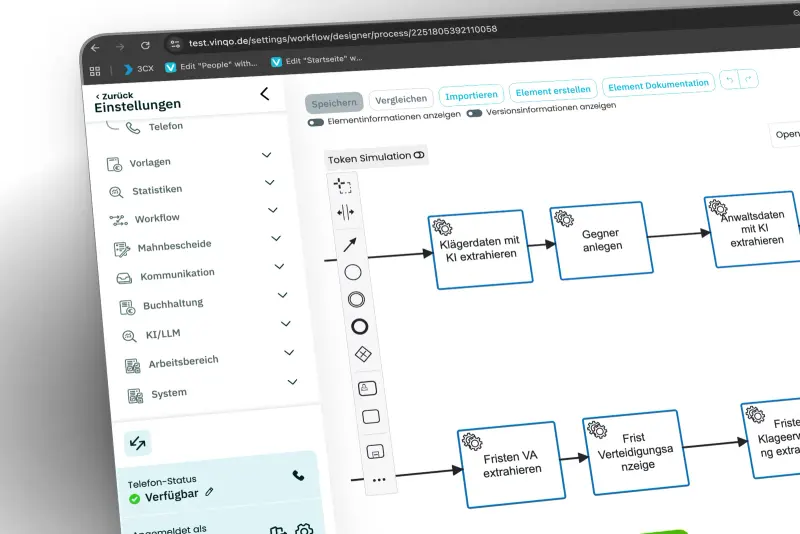
This is where the perspective of Legal Data Technology GmbH comes in. With DEPLAW, the company is developing a platform that makes precisely these types of proceedings capable of automated handling: recurring patterns are modelled once as a process and then processed at scale. AI agents analyse incoming pleadings, identify deadlines and set priorities. They are embedded as controlled steps in a workflow designed by people, not used as autonomous decision-makers. The idea behind this is strategic rather than technical: in mass proceedings, where one ruling can set the tone for hundreds of parallel cases, the ability to respond quickly and in a structured way is decisive for the entire group of cases.
Whether the courts keep pace in this arms race is a matter for legal policy. Whether the defending side keeps pace is a matter of its own organisation. The tools that claimants have long been using are open to defendants too, but they have to use them themselves.
Legal Data Technology GmbH observes the development of mass proceedings from the practitioner’s side: the DEPLAW platform has already been in use for years by insurers and legal service providers for the automated processing of high case volumes.