

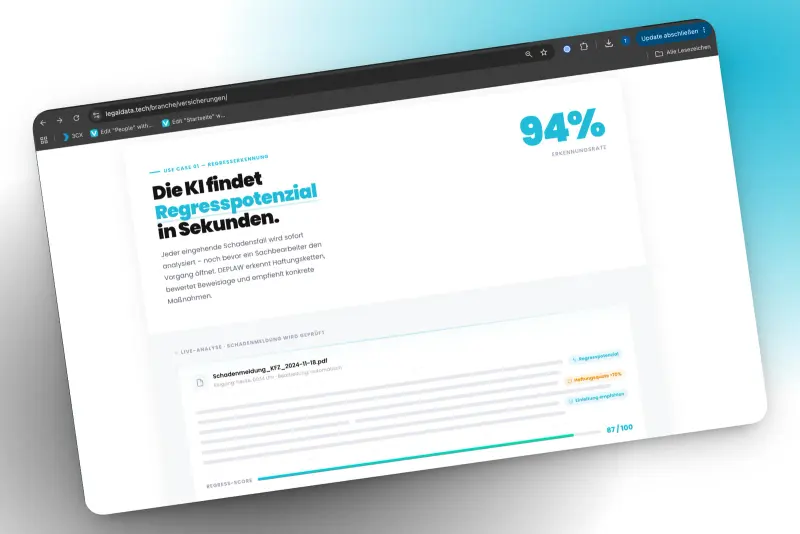
The claims files of liability insurers, legal expense insurers and health insurance funds hold recourse claims on a considerable scale. Most of the time, there is not enough capacity to identify them early in the claims files.
After an accident, the liability insurer settles the loss, the health insurance fund pays for medical treatment and the legal expense insurer bears the costs of the proceedings. In many of these cases, there is a right to reclaim the benefits paid from a third party.
Recourse is clearly regulated by law, and yet on a large scale it is not asserted. Often there is simply no time in day-to-day business to examine every case for a possible claim. With its platform DEPLAW, Legal Data Technology GmbH shows how this potential can be tapped systematically with the help of artificial intelligence.
Recourse claims: a detection problem
Whether a case is eligible for recourse depends on details: a third party’s involvement in how the accident happened, an indication of fault in a medical report, or a lawyer’s error that only emerges from the interplay of several documents. These indications are scattered across the case files – in loss notifications, treatment records, police reports and pleadings. Anyone who wants to find them has to review every single case carefully.
In practice, this can hardly be done with a reasonable staffing effort. With several thousand or tens of thousands of cases a year, there is no time to look at each one in the necessary depth. A considerable share of legitimate claims is lost this way and becomes time-barred without ever having been recognised as a claim.
“The most valuable recourse claims are often the ones that do not even stand out in day-to-day business. They are justified and enforceable, but simply disappear in the volume.”
– Tim Platner, managing director of Legal Data Technology GmbH
What AI does in recourse review
This is where artificial intelligence pushes back the limits of what is feasible. Where only a selection was reviewed before, AI can look at every case. The agents read loss reports, treatment records and case file information and recognise the patterns that point to recourse – such as third-party involvement, fault, the liability status of the party responsible, or the congruence of benefit and loss. Cases that would not have received a second look in manual handling thus become visible as a possible claim in the first place.
The same analysis also sharpens the view in the other direction. Anyone who recognises patterns that support a legitimate recourse claim equally recognises the anomalies that point to inconsistencies: contradictory statements about how the loss occurred, recurring constellations of parties, or deviations from typical loss patterns. Recourse review thereby also becomes a tool for fraud detection – a side effect of considerable value to insurers, because it arises without any additional review effort.
In a second step, the platform assesses the prospects of success. The amount of the loss, the share of liability, the evidence, limitation and comparable cases all feed into a structured assessment that ranks each identified claim by how enforceable it is. An unmanageable stock of cases thus becomes a reliable ranking by which resources can be allocated.
DEPLAW connects review, assessment and enforcement
Detection and assessment create the value; it is only realised through enforcement. What sets DEPLAW apart is that the platform brings all three steps together in one continuous process. A claim that has been identified and assessed as promising is not handed over to a separate case-processing team but continues in the same system.
Letters of claim are drawn up on the basis of the case file information and are sent via beA, the special electronic lawyers’ mailbox, or by post. Deadlines are monitored, responses from the other side are processed and the status of negotiations is kept up to date. AI agents carry out the individual steps as orchestrated building blocks of a process that a lawyer designs and controls at the decisive points. In this way, an identified claim becomes an enforced claim, without a case being lost between analysis and handling.
“Identifying a claim is one thing. Assessing and enforcing it in the same continuous process as well is what ultimately turns potential into realised claims.”
– Tim Platner, managing director of Legal Data Technology GmbH
Years of practice, not months of theory
Recourse automation cannot be switched on overnight. Legal Data Technology GmbH has set up the relevant systems with insurance customers over several years, tested them in live operation and refined them continuously. The AI agents that identify and assess recourse cases today are familiar not with sample data but with the actual data profile of claims files – with the document types, loss categories and liability constellations that occur in everyday work.
Relevance for liability, legal expense and health insurance
For liability insurers, every loss caused by a third party is a potential recourse claim. DEPLAW identifies these cases in ongoing operations instead of letting them fail because of a capacity bottleneck.
Thanks to detection that is specially adapted to outstanding reimbursements, lawyers’ errors in advice and litigation, and breaches of insurance terms and conditions, legal expense insurers can unlock comprehensive recourse potential.
Health insurers, both statutory and private, have claims against the party responsible after accidents, which in part are neither recorded systematically nor pursued consistently. In all three areas, the same principle applies: the claim already exists – what is needed is a system that identifies, assesses and enforces it.
For recourse automation, Legal Data Technology GmbH offers insurers and public bodies an individual process analysis based on their actual case portfolio. Find out more about detection rates, system integration and pricing models in the AI recourse review for insurers.